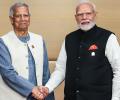
India has withdrawn the transhipment facility it extended to Bangladesh for exports to third countries, citing congestion at ports and airports. The decision comes after Bangladesh's interim government halted yarn imports from India and closed three land ports. The move has raised concerns about a downturn in India-Bangladesh relations following political instability and attacks on minorities in Bangladesh.

Rahul Gandhi engaged with German think-tanks and addressed the Hertie School in Berlin, discussing India's trajectory, democracy, and global cooperation. He also addressed the Indian community, emphasizing the importance of truth and democratic values.

China on Wednesday hit back at United States President Donald Trump's tariffs on Chinese exports with 84 per cent levies on its imports from America, intensifying the trade war between the top two economies of the world.
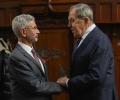
India's External Affairs Minister S Jaishankar addressed the Shanghai Cooperation Organisation (SCO) Council of Heads of Government meeting, advocating for a 'zero tolerance' approach to terrorism and emphasizing the need for the SCO to adapt to the changing global landscape.
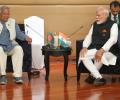
A former Bangladesh army officer and close aide of Chief Adviser Muhammad Yunus has suggested that Dhaka should collaborate with China to occupy India's northeastern states if it attacks Pakistan in response to the Pahalgam terror attack. Bangladesh's interim government has distanced itself from the remarks made by Major General (Retd) ALM Fazlur Rahman on his social media account. Rahman's comments come amidst growing tensions between India and Bangladesh following Yunus' remarks in China about India's northeastern states being landlocked and needing Bangladesh's access to the ocean. These incidents have further strained relations between the two countries, with India withdrawing transhipment facilities granted to Bangladesh for exporting goods to the Middle East, Europe, and various other countries.
Trump's remarks came amid heightened US messaging about the Iran situation and a series of White House statements indicating that multiple options remain under review.

'Today, we are at a stage where we have launched a voice-to-voice model that supports 14 Indian languages.'

'There are new job roles that are emerging because of AI.'

The current instability in the world is a result of long term systemic and socio-politico problems, points out Colonel Anil A Athale (retd).

The Natural History Museum, London, has officially unveiled the 24-image shortlist for the 2026 Nuveen People's Choice Award. This prestigious contest, a key part of the Wildlife Photographer of the Year competition and supported by lead sponsor Nuveen, invites the public to decide which image will be crowned the winner.
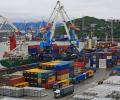
eclined for the third month in a row in January, falling by 2.38 per cent year-on-year to $36.43 billion, while the trade deficit widened to $22.99 billion in the month. Imports rose by 10.28 per cent year-on-year to $59.42 billion in January due to an increase gold shipments, according to the Commerce Ministry data. The trade deficit was $21.94 billion in December and $16.55 billion in January last year.

'It will increase the contribution to gratuity, which is something the employer has to give.'


With a confident new generation of innovators, India now has the scale and self-belief to shape its own digital destiny marked by creation, observes Ajay Kumar chairman, UPSC.

The 2025 US National Security Strategy marks a major pullback, with America turning backward and effectively allowing China greater dominance in Asia. while long-time partners like India are left to face an increasingly unstable global order largely on their own, observes Rajeev Srinivasan.

Funeral prayers were held for Bangladesh's former prime minister Khaleda Zia amid tight security. Millions joined the namaz-e-janaza of Zia, a three-time Prime Minister and political icon of Bangladesh.
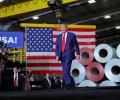
India maintains "high" import duties on a wide range of American goods such as agricultural items, drug formulations, and alcoholic beverages, besides imposing non-tariif barriers, a US report has said. A day before announcing reciprocal tariffs, the US Trade Representative (USTR) released the 2025 National Trade Estimate (NTE) Report on March 31.
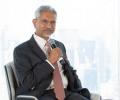
Jaishankar said that the Pahalgam attack "was an act of economic warfare. It was meant to destroy tourism in Kashmir, which was the mainstay of the economy. It was also meant to provoke religious violence because people were asked to identify their faith before they were killed."

The escalation of conflict in the West Asian region is expected to push already high logistics costs besides hurting trade in sectors such as oil, electronics and agriculture, according to exporters. They said that insurance costs for exports to the countries directly involved in the war could also go up, which will impact Indian exporters' working capital. Think tank Global Trade Research Initiative (GTRI) stated that the conflict is already hurting India's trade with countries like Israel, Jordan, and Lebanon.
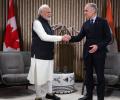
For Canada, important steps towards containing domestic elements that fuel pro-Khalistan sentiments can go a long way in signalling trust positively with regard to security and sovereignty, point out Harsh V Pant and Vivek Mishra.
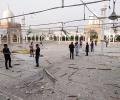
Chinese Foreign Minister Wang Yi stated that China mediated tensions between India and Pakistan, a claim disputed by India which maintains that the matter was resolved bilaterally.

United States President Donald Trump paid homage to soccer great Pele after being met with boos and cheers from the crowd at the Club World Cup final on Sunday at MetLife Stadium in East Rutherford, New Jersey.

'I am also thrilled to compete against some quality players in the opposition teams, it will be a good challenge for us.'

The answer is to be found in the rise of the global south and in particular, the rise of China, explains Aakar Patel.

The Vintage and Classic Car Club of India organised the annual Vintage Car Fiesta 2025 as a celebration of automotive history.

The CII Business Summit 2025's inaugural session witnessed a rousing standing ovation and a felicitation ceremony for the defence top brass sending a strong message about India's rising military industrial complex and hghlghting that security is a top-of-the-mind issue for India Inc.

Gearing up for Trump 2.0 era, Chinese President Xi Jinping on Tuesday cautioned there will be no winner in a tariff or tech wars between China and the United States and vowed that Beijing would firmly safeguard its interests.
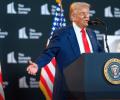
Sullivan remarks come amid the rising friction between Washington and New Delhi due to the 50 percent tariffs imposed on Indian goods, which include a 25 percent penalty for buying Russian oil.

Prime Minister Narendra Modi visited Ethiopia on a bilateral visit, engaging with Ethiopian leadership to strengthen partnerships in various sectors. He was warmly welcomed by Prime Minister Abiy Ahmed Ali and participated in cultural events, highlighting the strong ties between the two nations.
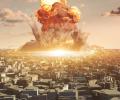
A step away from nuclear weapons being used in conflicts, warns Colonel Anil A Athale (retd).

'Don't look at Russia only as a place to earn quickly and then leave.' 'Try to build experience in serious companies, skills and certifications that will serve you anywhere in the world.'
Diplomats at WTO have become pessimistic about striking a trade deal.
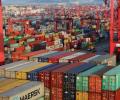
India's exports declined by 2.83 per cent to $33.90 billion in November this year compared to $34.89 billion a year ago, government data released on Friday showed. Imports also declined to $54.48 billion in the month under consideration, as against $56.95 billion recorded in November 2022.
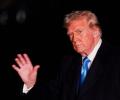
United States President Donald Trump on Sunday criticised the trade deficits that the US has with Canada, Mexico, China, and argued that America should no longer 'subsidise' other countries, and urged businesses to manufacture domestically to avoid tariffs.
Union Trade Minister Anand Sharma said on Monday that the impasse has been broken over the World Trade Organisation's long-running Doha round of trade talks.

It is shameful that Kashmir Times has been attacked in the way it has and that Anuradha Bhasin has not found more voices to speak in support of her and her paper, points out Aakar Patel.
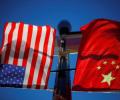
China on Tuesday retaliated US President Donald Trump's imposition of 2nd round of ten per cent tariffs on its export by slapping an additional 15 per cent tariffs on American goods and initiated legal action against Washington in WTO while leaving the door open for talks to address each other's concerns.
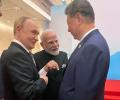
The relations between New Delhi and Washington are on a downturn after Trump doubled tariffs on Indian goods to a whopping 50 per cent, including a 25 per cent additional duties for India's purchase of Russian crude oil.
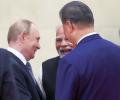
Navarro's remarks came after the public display of bonhomie by the three leaders on the sidelines of the Shanghai Cooperation Organisation (SCO) summit in Tianjin on Monday.
